


Written by MailClickConvert Team
Last updated: March 6, 2026
When you move from 500 emails per day to 5,000, then 20,000, and eventually run multiple campaigns across multiple domains, bulk email becomes an operational system.
At lower volume, things usually feel stable. However, once volume increases, patterns begin to change, this is because traffic flows through the same sending path every day, so when sudden change starts to show this is where the delivery starts to shift.
The reason is: Inbox providers are no longer looking only at your message. They evaluate your behavior, your sending setup, and your consistency over time.
At scale, you need to remember that deliverability is about discipline, not sending in high volume.
Here is how to improve your email deliverability without damaging or burning your domains.
1. Infrastructure Sets the Limits
Your authentication records, sending patterns, IP reputation, domain history, complaint ratios, and long-term consistency are also important for your email deliverability.
So if your SPF, DKIM, and DMARC are not configured correctly, you introduce doubt into every message before it is even opened.
Two common structural mistakes illustrate this clearly:
- Multiple domains sharing a single IP under heavy load, creating reputation overlap
- Spiking volume without warming infrastructure, triggering filters that are designed to detect abnormal behavior
Deliverability at scale is primarily a systems problem without using foundation, scaling simply accelerates instability.
2. Avoid the Single Relay Bottleneck
A single SMTP relay can work for moderate sending volume. At higher levels, it concentrates risk.
When all campaigns route through one relay:
- Complaint spikes affect everything
- Bounce rate changes influence all traffic
- Engagement shifts impact your entire sending history
This creates a fragile environment for you.
Using multiple SMTP relays distributes volume and isolates exposure. High-volume campaigns can operate independently from smaller or more targeted segments. If one path begins underperforming, adjustments can be made without disrupting the entire system.
For a detailed breakdown of how relays function in bulk environments, see our guide on How SMTP Relays Handle High Volume Sending.
Distribution improves stability because it reduces concentrated reputation pressure.
3. Respect Volume Increases
Inbox providers also track your behavioral history.
If your domain usually sends 3,000 emails per day consistently and then suddenly jumps to 20,000 overnight, that shift attracts attention from your email provider. Even when you have clean lists and relevant messaging this cannot fully offset abrupt changes in volume patterns, you need healthy growth that looks controlled.
Volume should only be increase gradually and daily cadence should remain consistent. New domains and IPs should be warmed before carrying full campaign load.
Warmup applies not only to brand-new domains but also to significant increases on established ones.
If growth feels rushed internally, inbox providers detect it externally through pattern analysis.
4. List Hygiene Is a Long-Term Discipline
As bulk volume grows, list quality becomes more influential.
At lower volumes, a handful of invalid addresses may not cause visible damage, but when you have 40,000 or 50,000 sent emails per day, that small percentages compound into noticeable bounce spikes, flagging you as suspicious.
You might not even realize your deliverability slowly declines and collapses.
Strong list discipline includes validating data before major sends, maintaining suppression lists, and removing chronically unresponsive contacts.
Platforms built for bulk campaigns require integrated validation and suppression controls because risk compounds quickly at higher volumes
Sending fewer verified contacts often produces more stable long-term performance than pushing maximum volume with uncertain data.
5. Separate Operational Domains From Core Brand Domains
Your primary business domain should not carry the full risk of bulk campaigns.
Even well-managed campaigns experience engagement variation. Certain industries respond less. Complaint ratios fluctuate across segments.
If all bulk traffic runs through your core domain, a temporary reputation dip can affect sales conversations, support emails, and transactional messages.
Dedicated sending domains or subdomains isolate that exposure.
This separation allows experimentation without risking critical communication channels. It also provides clearer visibility into which sending streams are stable and which need adjustment.
Compartmentalization protects reputation as volume increases.
6. Engagement Signals Shape Reputation
Deliverability is not only about technical setup. It is also about how recipients interact with your messages.
Inbox providers observe behavior if engagement declines while volume continues to rise, the imbalance becomes visible. Sending 100,000 emails with minimal interaction signals poor alignment between targeting and messaging.
Improving deliverability at scale often requires tightening segmentation.
Here’s way you can try to improve it:
Rather than blasting broad lists you can break campaigns into smaller, more relevant segments. You can also adjust messaging for specific industries and personalize it at a meaningful level, not just only inserting a first name.
7. Treat Deliverability as an Operational KPI
Deliverability should not be reviewed only when something fails. It needs consistent oversight, just like revenue or retention, always monitor your deliverability whenever you can.
At higher volume, early warning signs appear as gradual metric shifts. A slow increase in bounce rate may indicate declining data quality. A subtle drop in engagement may reflect audience fatigue. A slight rise in complaints may signal targeting misalignment.
Monitoring should include:
- Bounce trends
- Complaint ratios
- Inbox placement patterns
- IP and domain health signals
These metrics rarely collapse instantly. Teams that review deliverability weekly identify issues early saving themselves from further problems whereas teams that ignore it until campaigns underperform often face longer recovery periods.
Prevention requires your attention.
8. Understand the Limits of Traditional ESPs
Many mainstream email service providers focus on opt-in marketing models. Their infrastructure and compliance systems reflect that orientation.
They often restrict or prohibit using third-party lists because they understand when bulk volume increases inside those environments, problem appears and sending limits starts tighten.
Worst your accounts will undergo review and campaigns may be paused. Platforms designed specifically for bulk email infrastructure prioritize dedicated IP pools, controlled SMTP routing, domain-level separation, and integrated validation systems.
Using infrastructure aligned with your use case reduces instability as you scale.
Ready to Improve Bulk Email Deliverability?
If your bulk campaigns are increasing in volume and you need infrastructure that protects your domains while supporting growth, MailClickConvert provides a controlled sending environment built for bulk emailing.
With MailClickConvert, you get:
- Multi-SMTP relay distribution
- Built-in list validation and cleaning
- Deliverability monitoring and reputation tracking
- Infrastructure designed specifically for bulk campaigns
Instead of piecing together separate tools, you operate within a structured environment designed to protect reputation as volume increases.
If you’re serious about scaling bulk email without sacrificing inbox placement, explore MailClickConvert and see how a purpose-built infrastructure changes performance at scale.
Final Thoughts
Improving email deliverability at scale requires discipline.
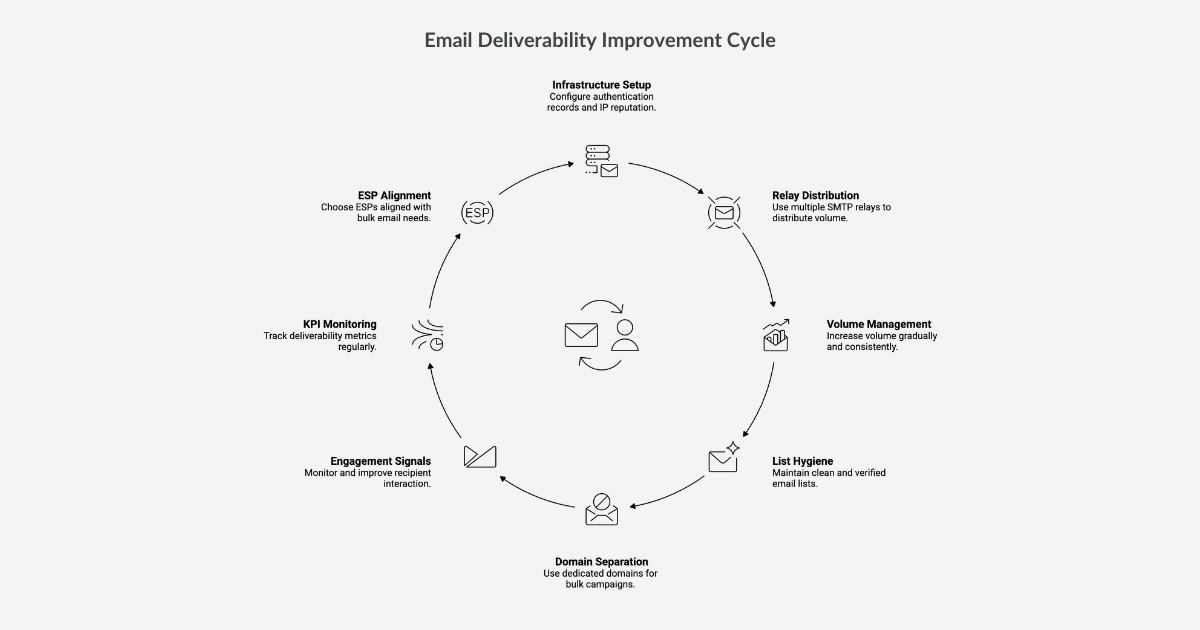
Strong authentication, distributed relays, gradual volume increases, strict list hygiene, and consistent monitoring form the foundation of stable bulk sending.
Bulk email is not just about volume. It is about maintaining trust while volume grows.
When systems are structured properly, scaling becomes predictable. When they are not, growth introduces instability.
Deliverability holds when infrastructure, data, and monitoring work together.
Scale carefully. Protect your domains. Build for volume from the beginning.
- Log in to post comments