


Author: MailClickConvert Team
Last Updated: January 20, 2026
Introduction
Bulk emails don’t fail on day one, and the problems teams experience rarely appear immediately. Issues usually begin when sending volume increases and campaigns move beyond their initial setup, even when early results seem fine.
A few hundred emails a day can perform well at the start, with replies and open rates continuing to come in, but that reliability often weakens as follow-ups increase and contact lists become larger.
An SMTP relay service sits between your sending system and inbox providers and controls how emails leave your servers, how quickly they are sent, how delivery failures are retried, and how consistent your overall sending behavior appears to inbox providers.
As sending volume increases, these delivery signals become more noticeable and start to influence results more than the structure of individual messages.
This article explains how SMTP relays handle high-volume sending, why bulk email sending is especially sensitive to delivery behavior, and what separates campaigns that remain dependable from those that slowly lose visibility.
What High-Volume Sending Actually Means in Bulk Email
High-volume sending does not have a single definition because it depends on several factors, including your domain history, how consistently you send, and how inbox providers already interpret your traffic.
The same sending level can look very different depending on whether it appears steady or sudden from the provider’s point of view.
For one team, high volume may mean sending 1,000 emails per day, while for another it may involve 20,000 emails per day or more.
The number itself matters less than how quickly that number changes and how evenly messages are distributed across the day.
Bulk email also operates under different expectations compared to newsletters or transactional messages. Recipients did not request the message, and engagement varies widely across contacts. Some emails receive replies or opens, while others are ignored entirely, and inbox providers factor these mixed responses into how they evaluate sending behavior.
As daily volume increases, even small variations in timing or delivery behavior become easier for inbox providers to detect, which is why consistency plays such a critical role in bulk email performance.
Learn more about the different of marketing and transactional emails 👉 Managing transactional vs marketing email.
Where SMTP Relays Fit Between You and the Inbox
An SMTP relay is the delivery layer that sends your emails from your application to recipient mail servers. Instead of your system connecting directly to Gmail, Outlook, or Yahoo, the relay handles that communication.
This matters because inbox providers do not just look at what you send. They look at how you send.
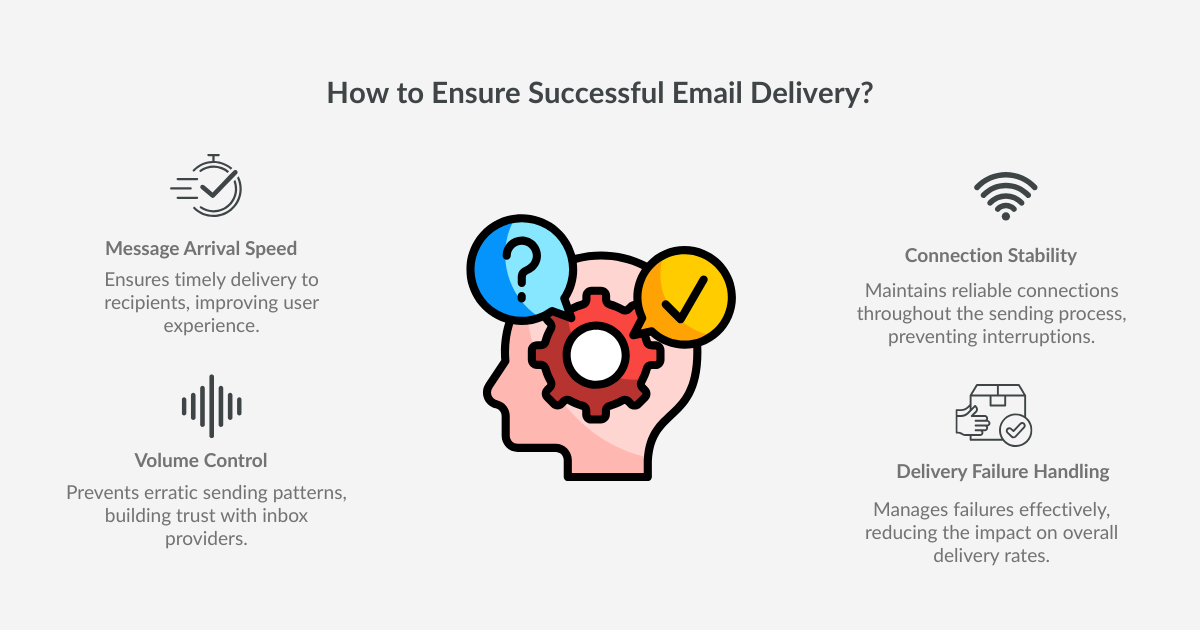
When inbox providers evaluate delivery behavior, they pay close attention to factors such as:
- how quickly messages arrive after they are sent
- whether connections remain stable throughout the sending process
- how delivery failures are retried and spaced out
- whether changes in sending volume appear controlled or erratic
All of these signals are managed by the SMTP relay. As sending volume increases, the relay becomes the main factor shaping how inbox providers interpret your behavior, which means consistent relay handling can support inbox placement, while poor handling can create delivery problems even when the campaign itself has not changed.
Read more: What is an SMTP relay and why it matters.
How SMTP Relays Manage Sending Speed at Scale
Sending faster does not mean better delivery.
When too many emails are released at once, inbox providers often respond by slowing delivery or temporarily deferring messages, and if a sending system continues to push traffic without adjusting, that behavior can appear careless from the provider’s point of view.
A good SMTP relay service manages speed with intention by releasing messages in controlled batches, reusing connections efficiently, and adjusting pacing when inbox providers signal limits. This approach creates a consistent sending rhythm that inbox providers can recognize and trust, rather than sudden bursts that draw attention.
Without this layer of control, many systems attempt to send as quickly as possible until delivery slows or errors appear, at which point problems have already begun to surface.
Learn more about dedicated vs shared SMTP.
Why Sending Patterns Matter More Than Raw Volume
Inbox providers do not evaluate a single campaign on its own, because their systems look at sending behavior across multiple days and weeks to understand what is normal and what is not. Instead of reacting only to individual messages, they assess patterns to determine whether sending appears consistent or unpredictable.
SMTP relays help smooth these patterns by reducing sharp changes that can draw attention, especially when activity increases due to factors such as:
- stacked follow-ups sent too close together
- new campaigns starting all at once
- large list uploads being sent in a single push
Sending that follows a gradual, even curve tends to perform better than traffic that rises and falls sharply throughout the day. Bulk email performs best when infrastructure behavior appears calm and predictable, because consistent sending reduces filtering pressure even as daily volume increases.
This aspect of delivery behavior is often overlooked, yet it plays a significant role in whether bulk email continues to perform reliably over time.
How SMTP Relays Handle Errors and Retries
When sending at high volume, it is normal for some emails to fail on the first delivery attempt, and those initial failures are not usually the problem. What matters is how the system responds after a message is deferred or rejected.
A strong SMTP relay handles retries with care by spacing attempts appropriately, waiting when inbox providers signal temporary issues, and stopping further retries when an error is clearly permanent. This controlled approach prevents unnecessary pressure on receiving servers and keeps sending behavior within expected limits. Poorly configured systems often retry too quickly or too frequently, which can make the sending pattern appear aggressive and unreliable.
Inbox providers pay close attention to this behavior. Repeated failed attempts, especially when they happen in short intervals, can damage sending reputation even when the original contact list is clean. At higher volumes, retry logic becomes directly tied to reputation, because the way failures are handled is treated as a signal of sender quality rather than a technical detail.
SMTP Relays and Domain Reputation Protection
SMTP relays help protect that reputation by enforcing stable delivery patterns, even when campaigns change or sending activity increases, which reduces the risk that one aggressive push affects the reputation relied on by future outreach.
Some SMTP relays add another layer of protection by separating different types of traffic or applying controls that prevent sudden changes in behavior from spreading across a sender’s entire history. This helps keep reputation signals isolated and prevents short-term activity from causing long-term damage.
For bulk email, this protection is especially important because engagement is naturally uneven across recipients. Infrastructure needs to absorb those variations quietly, rather than amplifying them into signals that inbox providers interpret as risky behavior.
What Goes Wrong When High-Volume Sending Is Not Managed
Most teams do not experience a single, obvious failure when high-volume sending. Instead, they notice a gradual decline in performance that becomes harder to manage. Open rates begin to fall, replies become less frequent, delivery slows, and messages stop appearing where recipients are most likely to notice them, even though no single change in the campaign stands out as the cause.
This pattern usually develops when several issues overlap, including:
- sending volume increasing faster than delivery controls can adjust
- follow-ups being scheduled too closely together without proper pacing
- retry behavior becoming too frequent or poorly spaced
- reputation signals weakening gradually without clear warnings
By the time these problems are clearly visible, fixing them often takes significantly more effort than it would have taken to prevent them in the first place.
Why Bulk Email Is More Sensitive Than Other Email Types
Bulk email operates without the benefit of prior trust, because there is no subscription history and no established relationship between sender and recipient, which naturally leads to wide variation in engagement from one contact to the next.
Some recipients may open or reply, while others ignore the message entirely, and this uneven response pattern shapes how inbox providers evaluate the sender.
Because lower engagement is expected in bulk outreach, inbox providers place greater emphasis on sending behavior and reputation signals when deciding how messages should be treated. In this context, SMTP relays play a critical role by controlling delivery patterns and ensuring that sending behavior appears stable and predictable rather than erratic.
When infrastructure maintains consistent delivery behavior, bulk email has the opportunity to perform as intended, but when that consistency breaks down, filtering pressure increases quickly and limits visibility. Unlike other email types, bulk email is far less tolerant of delivery systems that introduce irregular patterns or unmanaged sending behavior.
Engagement-Driven Sending Starts With Infrastructure
Strong bulk email performance depends on more than copy or personalization, because engagement is influenced by when messages are sent and how sending volume aligns with real recipient behavior.
Infrastructure plays a central role in this process by shaping delivery patterns that inbox providers can interpret as consistent and reliable.
SMTP relays support engagement-driven sending by allowing pacing to adjust and delivery behavior to remain predictable as conditions change. When engagement drops, systems that continue pushing volume without adjustment tend to create additional delivery pressure, while systems that adapt preserve stability and protect inbox placement.
In practice, infrastructure sets the limits within which engagement can occur, which means even well-written messages only perform as well as the delivery systems supporting them.
How MailClickConvert Approaches High-Volume Sending
MailClickConvert treats delivery behavior as part of the outreach strategy, not something to fix after results start failing. High-volume bulk email works best when sending patterns stay controlled, visible, and predictable as volume increases.
This approach is built around a few core principles:
- predictable daily sending patterns that avoid sharp shifts inbox providers notice
- gradual volume increases instead of sudden jumps that trigger scrutiny
- controlled follow-up timing so messages are spaced rather than clustered
- responsible retry handling that avoids unnecessary pressure on receiving servers
SMTP relay behavior is evaluated with long-term reputation in mind rather than short-term. MailClickConvert helps teams adjust before inbox placement is affected, making high-volume bulk email easier to manage and more reliable over time.
Final Thoughts
Bulk email rarely fails because messages are poorly written. In most cases, it fails because the delivery systems behind those messages cannot support the volume being sent in a consistent and reliable way. An SMTP relay services influence how your sending appears to inbox providers by controlling pacing, retry behavior, and overall consistency.
Clean lists, relevant messaging, and well-timed follow-ups can only work as intended when delivery remains stable, because even the strongest outreach strategy depends on systems that support it rather than undermine it.
- Log in to post comments