


Author: MailClickConvert Team
Last Updated: January 2026
Choosing an SMTP relay service is rarely treated as a priority. Many teams make the choice during initial setup, copy a few settings, and move on. Email starts sending, and everything looks fine on the surface.
Problems usually appear later. Messages arrive late. Campaigns struggle to reach inboxes. Transactional emails occasionally fail when users need them most. By the time these issues are visible, the cause is often buried deep in infrastructure choices made months earlier.
An SMTP relay provider plays a direct role in how messages move from your system to inbox providers. It influences SMTP email delivery, sending behavior, retry logic, and reputation signals. A poor choice can introduce delivery risk that builds quietly over time. A good one keeps delivery stable and problems visible before they grow.
This guide explains what actually matters when choosing an SMTP relay provider, focusing on delivery behavior, reputation management, and long-term reliability rather than feature lists or marketing claims.
What Does an SMTP Relay Provider Actually Do?
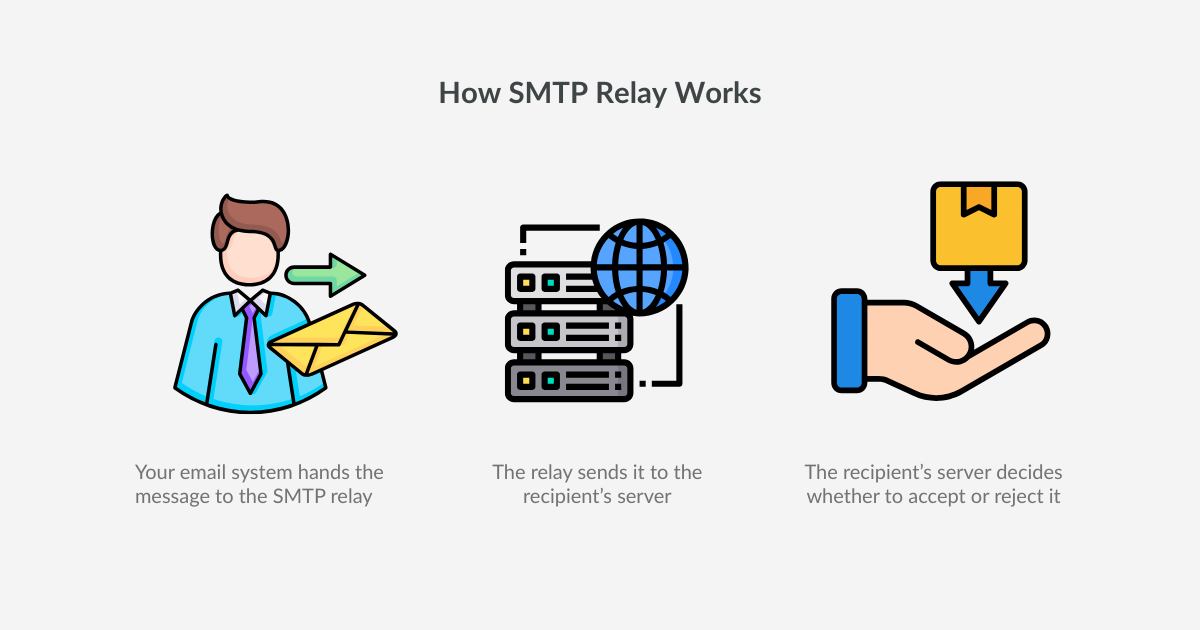
An SMTP relay is the service that delivers your emails from your application or platform to the recipient’s mail server. Instead of your system connecting directly to Gmail or Outlook, the relay handles that connection for you.
This matters because inbox providers care about how emails are sent. They look closely at sending speed, error handling, retry behavior, and sender history. An SMTP relay controls all these factors in the background, shaping how inbox providers interpret your sending behavior over time.
Most businesses rely on an SMTP relay when they send transactional emails, bulk announcements, or cold outreach at scale. Without one, delivery becomes unreliable very quickly as volume increases or patterns change.
Related read: 👉 What is an SMTP relay
Why Does Reliability Matter for SMTP Email Delivery?
Reliability in email delivery is often misunderstood. It is not about sending messages as fast as possible. It is about sending in a way that inbox providers can predict and trust.
Good SMTP email delivery means messages arrive when expected, without sudden delays, repeated retries, or unexplained drops. Some SMTP relay providers perform well at low volumes but struggle when sending increases, while others maintain steady behavior even as traffic changes.
Inconsistent delivery patterns create uncertainty. Inbox providers track how servers behave over time, and sudden spikes, erratic retries, or unstable connections can trigger throttling or filtering even if message content has not changed.
A reliable SMTP relay service focuses on steady connection behavior and controlled retries rather than repeated failures. This consistency builds trust with inbox providers and keeps delivery predictable for users.
How Do SMTP Relay Providers Manage Reputation and IP Quality?
Every SMTP relay provider influences your email server reputation, whether you manage it directly or not.
Reputation is shaped by how messages are sent, how recipients interact with them, and how problems are handled. A good provider actively monitors these signals and responds when risk increases instead of waiting for deliverability to collapse.
When evaluating providers, look closely at:
- how shared sending environments are monitored
- whether poor senders are isolated or allowed to affect others
- how quickly reputation issues are addressed once they appear
Strong reputation management protects critical messages, especially when marketing email deliverability fluctuates.
How Are Sending Limits and Volume Changes Handled?
SMTP sending limits exist for a reason. Inbox providers use them to prevent abuse and manage load, and the way an SMTP relay provider enforces these limits matters more than the limits themselves.
A poor provider simply blocks messages when limits are reached. A good provider manages volume in a way that aligns with normal sending behavior.
Effective volume handling usually includes:
- spreading sends over time
- adjusting delivery pace during spikes
- preventing sudden bursts that look unnatural
This approach is especially important for campaigns, product announcements, or situations where cold email deliverability is already sensitive. Proper volume control helps protect reputation without interrupting legitimate sending.
For more on protecting deliverability: 👉 How Sending Behavior Impacts Email Deliverability
How Should Transactional and Marketing Email Be Handled Differently?
Transactional email and marketing email serve different purposes and are treated differently by inbox providers. A capable SMTP relay provider should reflect this difference in how it handles delivery.
Transactional messages are expected by the recipient. They are often time-sensitive and usually receive strong engagement. Marketing messages are evaluated more strictly and depend heavily on ongoing interaction and consistency.
A good provider supports this separation by offering:
- different sending streams or delivery behaviors
- protection for transactional messages during marketing campaigns
- controls that adapt when engagement patterns change
Sending all traffic through one stream without distinction increases risk as volume grows.
Learn more about the different of marketing and transactional emails 👉 SMTP Relays for Marketing vs. Transactional Email
Why Is Visibility Into SMTP Delivery and Errors Important?
When delivery problems appear, visibility determines how quickly they are resolved.
An SMTP relay provider should clearly show:
- whether a message was accepted, delayed, or rejected
- why a delivery attempt failed
- whether an issue is temporary or permanent
Basic “sent” confirmations do not provide enough information. Clear feedback helps teams adjust sending behavior before issues spread and affect broader SMTP email delivery.
What Should You Expect From SMTP Setup and Ongoing Maintenance?
A good SMTP setup should be straightforward, even for teams without deep email expertise.
Initial setup typically involves authentication, routing rules, and basic sending configuration. Over time, maintenance should be minimal.
Providers that simplify setup help reduce:
- configuration errors
- inconsistent sending behavior
- operational overhead
Ease of use matters because most delivery problems do not come from large failures, but from small misconfigurations repeated over time.
What Security and Abuse Controls Should an SMTP Relay Provider Have?
SMTP relay providers must balance accessibility with protection.
Even legitimate senders can cause problems if abuse controls are weak. Providers should have safeguards in place to detect unusual patterns, handle complaints, and prevent misuse before it affects other senders.
These protections support stable infrastructure, shared environments, and long-term email reputation management.
How Do SMTP Relay Providers Support Email Sending?
The strongest SMTP relay providers do more than deliver messages. They reinforce email sending best practices through system behavior and defaults.
This means supporting consistent sending patterns, suppressing invalid or bounced addresses, managing volume changes gradually, and applying reputation-aware delivery logic. When best practices are built into the platform, teams are less likely to create delivery problems through normal use.
Read 👉 How SMTP relay helps on email sending
How MailClickConvert Helps With SMTP Relays
MailClickConvert evaluates SMTP relay providers with long-term delivery health in mind. Instead of focusing on raw speed or volume alone, the platform looks at whether a provider supports reliable, predictable sending over time.
MailClickConvert prioritizes providers that offer:
- consistent SMTP delivery across varying sending patterns
- protection of email server reputation in both shared and isolated environments
- support for transactional, marketing, and outreach use cases
- visibility into delivery results, errors, and engagement signals
- controls that reduce risk as volume grows
By treating SMTP infrastructure as part of the deliverability strategy, MailClickConvert helps reduce risk before it impacts campaigns or user experience.
Final Thoughts
Choosing an SMTP relay provider is not a one-time setup task. It is a long-term decision that affects every email sent, from critical notifications to marketing campaigns.
A reliable SMTP relay service supports clean SMTP setup, manages email routing carefully, enforces sensible sending limits, and protects reputation over time. As sending volume grows, these factors become more important, not less.
Prioritizing consistency, visibility, and reputation helps keep SMTP email delivery predictable and reduces the likelihood of problems that are difficult to correct once they emerge.
Frequently Asked Questions
What is an SMTP relay provider?
An SMTP relay provider is a service that sends email from your system to recipient mail servers on your behalf. It manages the connection, delivery behavior, retries, and sending patterns so inbox providers can evaluate your emails consistently.
Do I need an SMTP relay provider if I send low email volume?
Yes. Even low-volume senders rely on SMTP behavior, authentication, and reputation signals. Delivery problems often appear when volume changes or sending patterns shift, not only when volume is high.
How does an SMTP relay affect email reputation?
An SMTP relay influences reputation through sending consistency, retry logic, IP quality, and how errors are handled. Poor relay behavior can affect how inbox providers view your entire sending history.
Should transactional and marketing email use the same SMTP relay?
They can, but it increases risk as volume grows. Transactional email depends on speed and reliability, while marketing email is evaluated more strictly. Separating behavior or streams helps protect critical messages.
What should I look for first when choosing an SMTP relay provider?
Start with reliability, visibility into delivery results, reputation management, and how the provider handles volume changes. Feature lists matter less than long-term delivery stability.
- Log in to post comments