

Written by: MailClickConvert
Last updated: February 2026
Your email domain has a reputation score. Every time you send a campaign, inbox providers like Gmail, Microsoft, and Yahoo evaluate your sending behavior and adjust that score up or down. When your reputation drops, your emails land in spam folders or get blocked entirely. This is why SMTP relays matter for domain reputation protection, especially when you're running bulk email campaigns.
Most marketers focus on subject lines and copy while ignoring the infrastructure underneath their campaigns. But the sending systems you use determine whether anyone sees your message in the first place.
This article explains how domain reputation develops, how SMTP relays influence that reputation over time, and how marketers and sales teams can protect inbox placement when running bulk email campaigns.
What SMTP Relays Actually Do
An SMTP relay is a server that sends email on your behalf. Instead of your own mail server communicating directly with recipient inbox providers, the relay handles the delivery. This creates a buffer between your domain and the receiving servers.
When you send through an SMTP relay, the relay's IP addresses do the heavy lifting. Your domain still gets associated with the send (through authentication records), but the relay manages the actual connection, retry logic, and delivery attempts. This separation is the first layer of reputation protection.
Relays operated by email service providers typically maintain dedicated IP pools with established sender reputations. When you send through these IPs, you inherit some of that existing trust while building your own domain reputation over time.
Learn more on how smtp relay works What Is an SMTP Relay and Why It Matters for Email Sending
What an SMTP Relay Does in Bulk Email Marketing
An SMTP relay controls how emails are delivered from a sending account to inbox providers. In bulk email marketing, this delivery layer has a direct influence on reputation.
An SMTP relay controls:
- How emails leave the sending domain
- How fast messages are sent
- How delivery failures and retries are handled
Instead of pushing messages through all at once, the relay manages pacing and retries in a controlled way. Inbox providers observe these behaviors closely. How sending is handled often matters more than the content of individual emails.
A predictable delivery pattern helps inbox providers understand what to expect from a domain and reduces uncertainty around its behavior. This is why SMTP relays play a central role in bulk email deliverability.
How this works in bulk email delivery: How SMTP Relays Handle High-Volume Sending (And Why It Matters for Bulk Email)
SMTP Relay Rotation and Reputation Management
Relay rotation splits your volume across multiple SMTP servers. Instead of one relay handling all 10,000 sends, you route 2,500 through Relay A, 2,500 through Relay B, and so on. This prevents any single relay from accumulating too many complaints or negative signals.
Three ways to rotate:
- Round-robin - Cycle through relays in order, equal distribution
- Weighted - Route more volume through better-performing relays
- Failure-based - Monitor each relay, reduce volume when metrics drop
Pacing matters as much as rotation. Sending 10,000 emails in 5 minutes looks like spam, even with rotation. Spreading the same volume across 4 relays over 2 hours looks like legitimate email.
Rotation extends how long your sending setup stays healthy and prevents any single relay from getting hammered with complaints. But it doesn't fix fundamentals. If your lists are full of invalid emails or your messaging gets ignored, rotation just delays the inevitable.
The Problem With Single-Provider Sending
Many email marketers send all their volume through one SMTP provider. This works until it doesn't.
If that provider experiences deliverability issues, your campaigns suffer. If your sending patterns trigger blocks on their IP ranges, you have no fallback. If they change policies or pricing, you're locked in.
Single-provider dependency also concentrates risk. All your sending reputation data lives with one service. Your domain reputation becomes tied to their infrastructure performance.
How Sending Behavior Shapes Domain Reputation Over Time
Inbox providers track patterns in your sending. They're watching volume consistency, bounce rates, spam complaints, and engagement signals. A sudden spike from 1,000 emails to 50,000 looks suspicious. High bounce rates suggest you're sending to bad addresses. Complaints indicate recipients don't want your mail.
SMTP relays help shape these patterns by enforcing consistent delivery behavior. When sending remains steady and predictable, domains are more likely to retain inbox placement as volume grows.
Engagement and Reputation in Bulk Email Campaigns
In bulk email campaigns, replies are not always the end goal. Inbox providers look at more engagement signals that indicate whether recipients are interacting with messages in expected ways. Opens, clicks, and time spent engaging with an email are often stronger indicators from sending email messages especially from overall recipient interest across large audiences.
Only a small portion of bulk email audiences are expected to reply, even when messages are relevant. Engagement behaviors such as opening, clicking, and reading occur at much higher rates, giving inbox providers a more reliable view of how the wider audience responds.
When engagement remains healthy across these signals, domain trust becomes better however when opens and clicks decline consistently, inbox providers begin to reassess placement. This change often happens gradually, with more messages filtered away from the primary inbox before any clear delivery errors appear.
Sending behavior should reflect these engagement trends. Continuing to send the same volume when opens and clicks decline can weaken domain reputation over time. Monitoring engagement patterns allows teams to adjust volume and pacing before longer-term delivery issues develop.
A Practical Framework for Protecting Domain Reputation
Protecting domain reputation in bulk email marketing depends on steady habits rather than short-term fixes.
Effective practices include:
- Using verified and validated contact lists
- Increasing sending volume in measured steps
- Keeping follow-up timing predictable
- Monitoring engagement before adding more volume
When engagement slows, holding volume steady is often safer than increasing activity. These habits help domains remain trusted over time and reduce the risk of gradual performance decline.
Common Bulk Email Mistakes That Damage Reputation
Many reputation issues come from avoidable mistakes rather than complex problems.
Common issues include:
- Increasing volume before trust is established
- Treating SMTP relays only as throughput tools
- Ignoring early engagement decline
Trying to fix delivery problems by changing messaging alone rarely works. Domain reputation is shaped by how emails are sent, not just what they say.
What to Do When Domain Reputation Fails
Spam folder placement is the most common failure. Your emails get delivered technically, but they land in spam instead of inbox. Open rates drop to near zero, conversions stop, and revenue collapses.
SMTP blocks are complete failure. The receiving server refuses your mail entirely. Blocklists are particularly brutal because getting listed on Spamhaus or SURBL means multiple providers block you simultaneously.
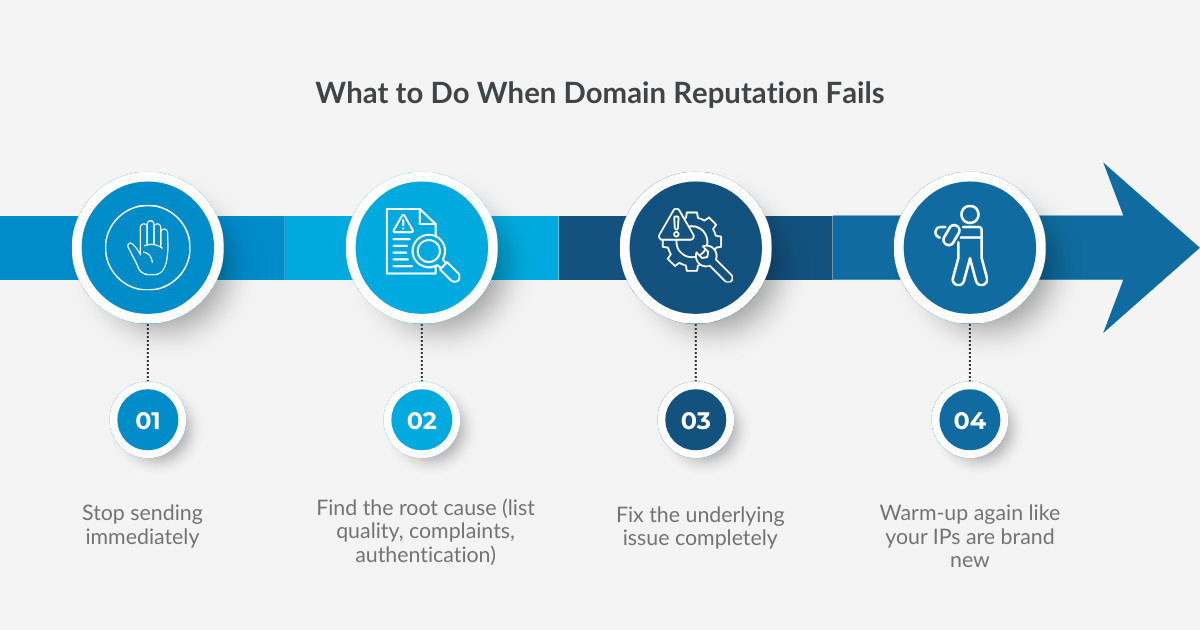
Recovery process:
- Stop sending immediately
- Find the root cause (list quality, complaints, authentication)
- Fix the underlying issue completely
- Warm-up again like your IPs are brand new
For severely damaged setups, new dedicated IPs often work better than trying to rehabilitate poisoned systems.
Check blocklist status across providers: Mailivery Blocklist Monitoring
How MailClickConvert Supports Bulk Email Reputation Management
MailClickConvert treats sending behavior as part of overall campaign health rather than a background technical concern. Bulk email performance depends on how sending, list quality, and monitoring work together over time.
The platform brings these pieces into one coordinated setup:
- SMTP relay management that takes care of pacing, retries, and relay rotation across multiple providers
- Email verification to protect list quality and reduce risk from invalid or unsafe addresses
- Authentication and deliverability monitoring to help maintain domain trust as volume increases
- Managed email marketing support that aligns sending behavior with inbox provider feedback
This approach helps domains remain trusted and supports more consistent inbox placement in ongoing bulk email programs, without teams having to build or maintain delivery infrastructure themselves.
Try MailClickConvert - a bulk email platform with features like advanced list management, campaign management, and SMTP relay rotation, all built to protect your domain reputation and maximize inbox placement
Useful Resources
- Understand how Gmail evaluates senders: How Gmail Determines Email Placement
- See how Microsoft evaluates sending behavior: Exchange Online Mail Flow Best Practices
- See how Yahoo evaluates sender trust: Yahoo Sender Best Practices
FAQ Section
Frequently Asked Questions
What is an SMTP relay for bulk email marketing?
An SMTP relay for bulk email marketing controls how large volumes of email are delivered from a domain to inbox providers. It manages pacing, retries, and provider routing so sending behavior appears consistent over time.
How does an SMTP relay affect domain reputation?
Inbox providers judge domains based on sending patterns. An SMTP relay shapes those patterns by controlling delivery speed, retry behavior, and consistency, which directly influences how a domain is trusted.
Why does bulk email deliverability decline even when lists are clean?
Clean lists reduce risk, but deliverability also depends on how email is sent. When volume increases faster than engagement or delivery behavior becomes inconsistent, inbox providers reduce placement over time.
What is SMTP relay rotation and when should it be used?
SMTP relay rotation distributes sending across multiple providers to avoid placing too much volume on a single route. When managed carefully, it supports steadier delivery behavior. Poorly managed rotation can weaken reputation.
How long does it take to rebuild domain reputation?
Rebuilding domain reputation takes time. Inbox providers look for consistent improvement across weeks, not short-term changes. Stable sending behavior and engagement trends matter more than temporary adjustments.
- Log in to post comments