

Author: MailClickConvert Team
Last Updated: March 2026
Running email campaigns at scale often starts simply. A team launches a campaign from one domain using one sending connection. Performance looks stable, so they increase volume. Soon they add another campaign, then another domain, and eventually several campaigns are running at the same time.
At first, the results look easy to manage, but later patterns begin to shift, and it starts to become difficult to read. One campaign performs well while another struggles with spam placement. Open rates decrease. Replies slow down even though the copy and targeting appear similar.
Many teams assume the problem is with the content. In reality, the issue often lies with the sending infrastructure. When all campaigns pass through a single relay path, reputation signals begin to concentrate. SMTP relay rotation working across multiple SMTP relays changes this by distributing traffic across several sending paths instead of forcing everything through one connection.
Understanding how relay rotation works within a multi-SMTP infrastructure becomes important once campaigns reach meaningful volume. At that stage, deliverability is shaped as much by infrastructure behavior as by the campaigns themselves.
Why High-Volume Email Sending Creates Infrastructure Pressure
Email systems behave differently when sending in bulk. When a few hundred emails are sent per day, the infrastructure handling those messages rarely attracts attention. Traffic levels remain good, and patterns are simple.
As sending volume grows into the thousands or tens of thousands, inbox providers begin evaluating broader signals. They observe how consistently messages are sent, how traffic flows through sending paths, and whether patterns remain stable over time.
When all campaigns rely on a single relay connection, that path carries the entire reputation of the sending program. Small changes in one campaign can affect the overall signal attached to that relay.
For example, a campaign targeting a less responsive audience may produce higher bounce rates or lower engagement. If the same relay handles every campaign, those signals blend together.
This concentration is one of the reasons high-volume sending systems rely on multiple relays rather than a single path.
👉 Read more about how SMTP relays differ by use case: SMTP Relays for Marketing vs. Transactional Email
What Multi-SMTP Relays Actually Do
Multi-SMTP relay infrastructure allows email platforms to route messages through several relay servers instead of relying on one connection.
Each relay processes a portion of the total sending volume. Rather than funneling all traffic through a single relay, the system distributes email across several available routes.
This structure changes the way sending behavior appears externally.
When several relays handle the traffic:
-
Sending volume becomes more evenly distributed
-
Reputation signals develop across multiple paths
-
Campaigns operate with greater independence
The emails themselves do not change. What changes is how the sending system manages delivery.
Distributing traffic reduces the concentration of sending signals that can trigger filtering systems.
👉 Learn more about SMTP fundamentals: What Is an SMTP Relay
How SMTP Relay Rotation Works Inside Multi-Relay Infrastructure
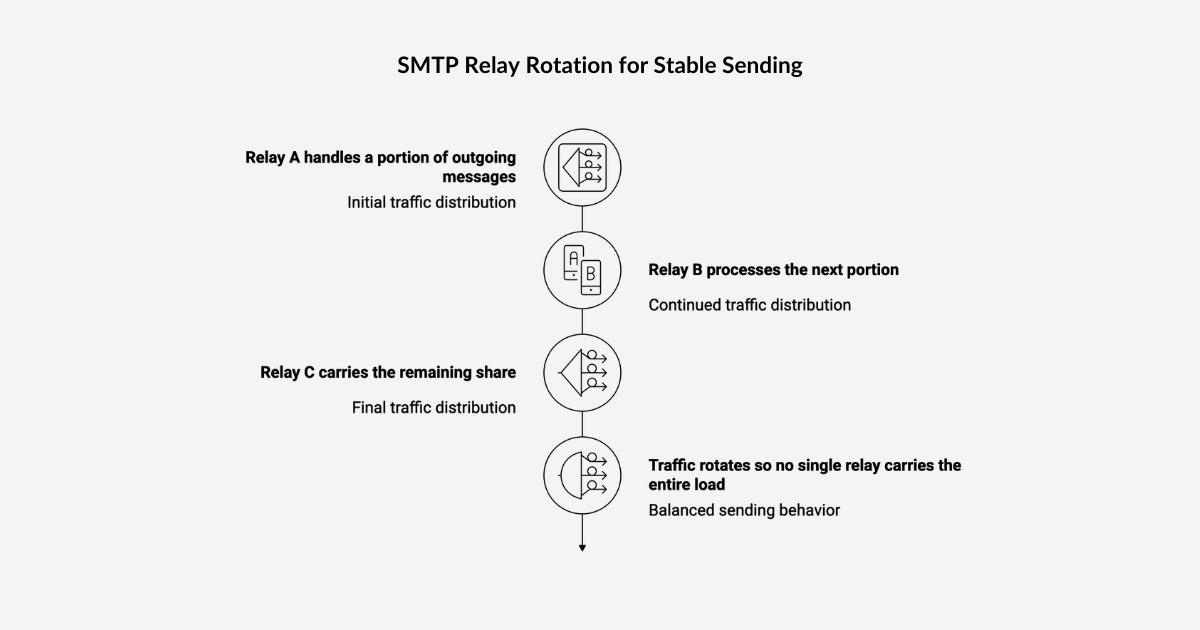
Relay rotation determines how traffic moves between available SMTP relays.
Instead of assigning all campaigns to one relay, the system rotates sending activity across multiple relay servers according to defined rules. Each relay receives part of the traffic, either sequentially or through load-balancing mechanisms.
For example, a sending platform might rotate traffic between three relays:
-
Relay A handles a portion of the outgoing messages
-
Relay B processes the next portion
-
Relay C carries the remaining share
As sending continues, the system rotates traffic so no single relay carries the entire load.
This distribution prevents one path from accumulating the full reputation signal of the sending program. It also allows infrastructure systems to adjust routing if one relay begins experiencing performance changes.
Rotation is not designed to increase speed. Its purpose is to create stable and balanced sending behavior.
👉 Learn more about infrastructure choices: Dedicated SMTP vs Shared SMTP for Bulk Mailing
Why Relay Rotation Improves Deliverability Stability
Inbox providers evaluate sending behavior over long periods. They watch for patterns that resemble normal communication activity rather than sudden spikes of traffic.
When a single relay carries all outgoing email, sending patterns can appear concentrated. Large bursts of traffic may travel through the same path repeatedly, which increases scrutiny.
Relay rotation spreads that traffic across several relays.
This distribution produces more balanced sending patterns and reduces the chance that one relay becomes associated with the entire sending reputation of the program.
The result is greater stability across campaigns. One campaign experiencing weaker engagement is less likely to influence the infrastructure supporting others.
When Email Programs Need Multi-SMTP Relay Rotation
Not every email program requires relay rotation. Small campaigns sending limited volume from one domain may operate reliably with simple infrastructure.
Rotation becomes valuable when sending complexity increases.
Common situations include:
-
campaigns running from multiple domains
-
outreach programs sending thousands of emails per day
-
agencies managing campaigns for multiple clients
-
parallel campaigns targeting different audiences
In these environments, traffic patterns begin overlapping if infrastructure remains centralized. Relay rotation helps separate those patterns so campaigns do not unintentionally affect one another.
What Happens Without Relay Rotation
When infrastructure does not distribute traffic across multiple relays, several issues may appear gradually.
Campaign results may begin diverging even when messaging and targeting remain similar. Teams often see patterns such as:
-
inconsistent inbox placement between campaigns
-
sudden engagement shifts in certain domains
-
reputation signals that appear shared across campaigns
These patterns can be difficult to diagnose because the campaigns themselves appear unchanged. The underlying cause is frequently the concentration of sending signals within a single relay path.
Infrastructure limitations tend to surface slowly rather than through a single visible failure.
Evaluating Multi-SMTP Relay Infrastructure
Not every platform that supports SMTP connections manages relay rotation effectively. The key factor is how well the infrastructure distributes traffic and separates campaign signals.
When evaluating a sending system, it helps to consider several infrastructure elements:
-
how traffic is distributed across available relays
-
whether campaigns can be isolated across relay paths
-
visibility into relay performance and reputation signals
-
the ability to adjust routing when performance changes
These controls allow sending systems to maintain stable patterns even as campaign volume grows.
High-volume email programs rely on infrastructure that can manage traffic intelligently rather than simply pushing more messages through a single path.
👉 Read more about choosing the right SMTP relay provider: Choosing an SMTP Relay Provider
Ready to Improve Bulk Email Deliverability?
As email campaigns grow in volume, sending infrastructure becomes just as important as the campaigns themselves. When all traffic flows through a single relay, reputation signals concentrate and small issues can affect the entire sending program.
MailClickConvert provides infrastructure built for bulk email programs that require greater stability.
With MailClickConvert, you get:
• Multiple SMTP relay routing to distribute sending traffic
• SMTP relay rotation that balances email volume across relay paths
• Built-in email validation and list hygiene tools to reduce bounce risk
• Deliverability monitoring and reputation insights to detect issues early
Instead of sending every campaign through one relay connection, MailClickConvert distributes traffic across a structured environment designed for high-volume outreach.
If your campaigns are scaling and you need infrastructure that supports reliable delivery, try MailClickConvert and see how multi-SMTP relays improve sending stability at scale.
- Log in to post comments