AGENCIES Agencies and partners

The email arm you never wanted to build.

Run outbound for clients on our infrastructure under your own name. Whitelabel domains, isolated sending per client so one bad list cannot touch another, and lists clients can use but not walk off with. You keep the relationship and the margin.

What it covers
  • Whitelabel domains
  • Isolated per client
  • Leased and locked lists
  • We never contact your clients
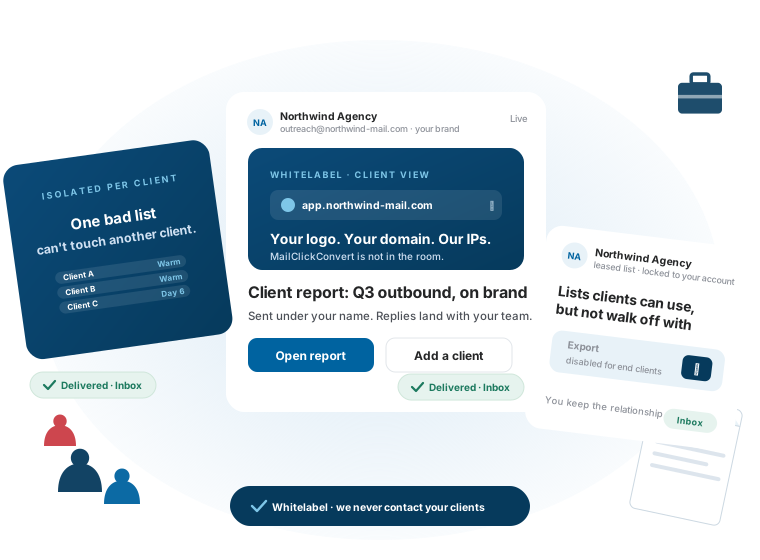
Three agency emails landing in the inbox: a whitelabel client report under the agency's own domain, an isolated-per-client sending panel, and a locked leased-list notice, each stamped delivered
20B+Emails delivered
250k+Campaigns completed
4,000+Customers
1B+Contacts validated
The problem

Clients want outbound. Building the infrastructure is not your business.

The short answer

You can run cold email for clients on our infrastructure under your own name. Whitelabel login domains, a co-branded interface, isolated sending per client so one account's mistake cannot touch another's, and reporting logins you can sell. You keep the client relationship and the margin. We stay invisible.

Why it breaks here

Why running client outbound in-house goes wrong.

Agencies rarely fail at outbound because of the campaigns. They fail because of how the sending is structured underneath.

One client's list burns the others

Shared infrastructure means a single bad file moves placement for every account on it. This is the risk that stops most agencies offering outbound at all.

The client's data breaches the platform terms

Purchased and consumer files get accounts closed, usually mid-campaign and usually on the client the agency can least afford to lose.

Volume needs hundreds of mailboxes

Mailbox-based tools do not scale to client volume without an inbox farm to buy, warm, monitor and pay for.

The client can walk off with the data

Lists you sourced and paid for leave with the account unless they are leased or locked.

Your vendor markets to your clients

Nothing ends a reseller relationship faster than a client being sold to directly.

How agencies use it

Six things agencies run on this.

Whether you resell the platform, run campaigns as a service, or hand us the difficult accounts, these are the jobs it actually does.

Delivery

Running client campaigns

The core of it. Build, send and report on outbound for clients who never see a platform, with isolated infrastructure per account.

What it needsSeparate domains and IPs per client, so one bad file cannot move placement on another.
Reselling

Selling accounts under your brand

Buy volume, sell seats, keep the spread. Clients log into something with your name on it.

What it needsWhitelabel login and signup domains, plus private reporting logins you can price.
New business

Prospecting for the agency itself

Agencies are usually the worst at marketing themselves. The same infrastructure runs your own pipeline.

What it needsB2B targeting by industry, size and title, on your own sending profile.
Overflow

Handing us the hard accounts

The client whose data or volume is beyond what you want to own. Managed outbound runs it white-labelled behind you.

What it needsReporting in your brand, and we never contact your clients directly.
Data

Sourcing lists clients cannot walk off with

Lease data to a client in a form they can use but not export, or split a list by record count across several.

What it needsLeased and locked lists, secure sharing with download limits.
Reporting

Numbers clients will accept

Live opens, clicks, replies and conversions per client, exportable, and sellable as its own product.

What it needsPer-client logins showing only their own data.

Data

Source it here, or bring the client's own.

Clients arrive with lists of wildly varying quality, and often with none at all. B2B data can be sourced inside the platform, and anything a client supplies runs verification before a first send.

The data you sourced stays an asset rather than a leaving present. Lists can be leased or locked so a client can send to them but not edit or download them, and shared links carry download limits. That matters more in an agency arrangement than anywhere else on this site.

What you get

Three things an agency needs that a normal account does not.

Your brand

Whitelabel, not co-branded-if-you-ask

Custom login and signup domains with a co-branded interface, so clients never see a third party in the chain. The platform carries your name, and we are not in the room.

Isolation

One client's problem stays theirs

Every end client gets isolated infrastructure. A bad list on one account cannot damage placement on another, which is the risk that makes most agencies avoid running outbound in-house at all.

Control

Lists clients cannot walk off with

Split a list by record count across clients, or lease data in a form they can use but not export. Secure sharing with download limits. The data you sourced stays an asset rather than a leaving present.

How agencies use it

Three models, and they are not exclusive.

1

Resell the platform

You buy volume, sell accounts, and keep the spread. Private reporting logins per client, mass management across accounts, and fast switching so one operator can run many.

2

Run campaigns as a service

Clients never see a platform at all. You operate everything and deliver results, and the infrastructure is a cost line rather than a product. Most agencies start here.

3

Hand the difficult ones to us

When a client's data or volume is beyond what you want to own, managed outbound runs it white-labelled behind you. Reporting can carry your brand and we never contact your clients directly.

You keep the relationship and the margin. We do not contact your clients, we do not market to them, and nothing in the interface invites them to come to us directly. That is a commitment rather than an oversight, and it is the reason agencies stay.

The terms

What a partner account runs on.

A partner sits between us and the end client, and that creates one predictable problem: we carry the reputation risk while you choose the data, write the copy and set the pace — with a client already paying you monthly. Goodwill does not fix that. These five conditions do, and they are agreed at signing rather than argued about mid-campaign.

1

Graduated volume

Every partner starts with a volume ceiling on isolated infrastructure. Headroom unlocks as complaint, bounce and placement figures stay clean. Think of it as a credit limit — it takes us out of the argument entirely.

2

A gate per end client

You are not the unit of risk; your clients are. A careful agency can still be handed a disastrous end client. Each new one passes a short check: data source, list size, content, aging plan.

3

The Standard is contractual

Aging period, verification, plain text, staged ramp and our right to pause go in the agreement, not just on a page. Agreed at signing, so it is never a mid-campaign fight.

4

Kill criteria, named upfront

Complaint rate, bounce rate and blocklist status have agreed thresholds. Crossing one pauses the send automatically. Nobody argues with a number they signed.

5

We never promise your client a result

In writing: we commit to delivery and inbox placement. If you have promised your client leads, that is your commitment, made with your knowledge of their offer. We will not undercut it and we will not be held to it.

The exclusions are the product

An agency can only put us near its book of business because of what we refuse to do. This is not a list of things we have not got around to.

  • We do not manage your clients' campaigns
  • We do not contact your clients directly
  • We do not compete with you for the relationship
  • We do not charge you retail — partner terms are wholesale
Why agencies come to us

Usually because a client's list got them thrown off something else.

Agencies bring us the sending their own stack cannot take: consumer audiences, purchased lists, volume that would need hundreds of mailboxes. The moment a mainstream ESP closes an account mid-campaign is usually the moment the search starts.

01

Purchased and cold data

Accepted on every plan, with no approval queue waiting to shut the account down after the file is uploaded.

02

Consumer as well as B2B

Consumer files and aged databases run alongside B2B prospecting rather than being a policy problem.

03

Volume without mailboxes

A million a month is a plan change, not 800 inboxes to buy, warm and monitor. See dedicated IPs.

04

Someone to call

A named contact who knows your accounts, rather than a ticket queue that has never heard of you.

Who we work with

Four kinds of agency, one structural need.

Full-service marketing agencies

Outbound is one line in a bigger retainer, and it must not become an operational problem.

Lead generation agencies

Outbound is the product. Volume and data quality decide the margin.

Political and advocacy consultancies

Cyclical volume across several clients at once. See political and advocacy.

Resellers and white-label operators

Selling the platform itself, where isolation and whitelabel are the whole proposition.

Plans start at $249 a month.

Agencies buy volume and price clients however they like. The spread is yours. Every plan carries dedicated IPs, verification credits worth 25% of your send volume, and no annual contract. Setup is a one-off $99.

Other industries

We do this for other sectors too.

Questions

Agencies and partners, answered.

Can we run this under our own brand?
Yes. Custom login and signup domains with a co-branded interface, so clients see your name rather than ours. Reporting can be white-labelled too, and we never contact your clients directly or market to them.
What stops one client's bad list damaging another client?
Isolated infrastructure per end client. Each account sends on its own IPs and domains, so a complaint spike or a bad file on one cannot move placement on another. This is the specific risk that stops most agencies running outbound in-house, and it is the main structural reason to do it here.
Can clients export the data we sourced for them?
Only if you allow it. Lists can be leased or locked so a client can send to them but not edit or download them, and shared links can be password protected with a cap on downloads. You can also split a list by record count and distribute pieces across clients.
Do you sell to our clients behind our back?
No. We do not contact them, market to them, or put anything in the interface inviting them to come to us directly. You keep the relationship and the margin. That is a deliberate commitment rather than something we have simply not got round to doing.
What if a client's program is beyond what we want to run?
Hand it to us. Managed outbound operates white-labelled behind you, with reporting in your brand, and we still never contact the client directly. Plenty of agencies run most accounts themselves and pass us the two that need dedicated attention.
How does pricing work for an agency?
You buy platform volume and price your clients however you like. The plans are the same ones on the pricing page, and the spread is yours. For larger reseller arrangements the volume is quoted rather than listed.
Get started

Tell us about your book.

How many clients, what they send, and what has gone wrong on your current stack. We will tell you which model fits and what the margin looks like.

  • Isolated infrastructure per client, so one file cannot burn the rest
  • Your brand on everything the client touches
  • We never contact or market to your clients

Prefer to talk? 1-800-604-5058

We reply within one business day. No sequence, no drip.

Your name on it. Our infrastructure under it.

Most agencies find us the week a client's list gets them removed from something else. Tell us what you are running and we will tell you how it works here.